

Views: 0 Author: Site Editor Publish Time: 2026-09-01 Origin: Site


Scaling visual appeal in commercial baking requires balancing aesthetic trends with strict margin control and food safety compliance. As production volume increases, sourcing decorative elements like edible pearls and glitter transitions from a simple retail purchase to a complex supply chain challenge. Inconsistent batch colors, ingredient separation, and non-compliant additives can derail production schedules and risk regulatory action. You need reliable materials that perform consistently under commercial conditions. Managing high-speed finishing lines means you cannot afford clogged dispensers or bleeding colors on your buttercream. This guide provides a technical framework for evaluating, testing, and selecting a reliable partner for high-volume edible decorations, ensuring operational efficiency and product consistency. We outline exact testing protocols for moisture migration, freeze-thaw resilience, and bake stability to protect your product quality.
Compliance is Non-Negotiable: Verify that all bulk decorative items meet local food safety standards (FDA, EFSA) with up-to-date Certificates of Analysis (COAs) and clear allergen documentation.
Performance Dictates Yield: Evaluate decorative elements based on bake stability, freeze-thaw resilience, and resistance to color bleeding in high-moisture environments (like buttercream or glazes).
Strategic Sourcing Lowers Unit Costs: Transitioning from retail tubs to true wholesale procurement requires analyzing Minimum Order Quantities (MOQs), shipping logistics, and shelf-life to calculate the true landed cost.
Customization Drives Brand Identity: Leveraging OEM capabilities for bespoke colorways and mixes can create a defensible aesthetic moat for commercial dessert brands.
Selecting the right cake decoration supplier directly influences your production floor efficiency and final profit margins. Standard retail sourcing eats into commercial margins rapidly. You must analyze the cost-per-gram difference between off-the-shelf tubs and tiered wholesale trade agreements. Securing bulk volume contracts stabilizes your material costs. This allows you to forecast annual expenses accurately without seasonal supply shocks.
Production consistency relies heavily on uniform raw materials. Batch-to-batch color variations force decorators to adjust designs manually, slowing down the line. Irregular sizing causes severe bottlenecks on automated or semi-automated finishing lines. When dispensing equipment jams due to oversized sugar pearls, you lose valuable production time and increase maintenance overhead. Standardized decorations keep machinery running smoothly and reduce manual intervention from your floor staff.
Visual marketing drives modern bakery sales. Highly reflective, camera-ready finishes on decorative elements directly correlate to premium retail positioning. Customers expect desserts that look flawless on social media. A brilliant, metallic sheen on a cupcake or a perfectly uniform pearl border elevates the perceived value of the product. This visual appeal translates directly to higher customer engagement and increased sales volume across your distribution channels.
Proprietary aesthetics build strong brand recognition. When you use custom mixes, you create a distinct visual signature. Customers begin to associate specific color combinations and textures with your brand. This standardization impacts customer retention in highly competitive bakery markets. A unique visual identity makes your products instantly recognizable in a crowded pastry case, separating your offerings from generic competitors.
Procuring wholesale glitter beads requires rigorous technical evaluation. You cannot rely on visual samples alone. You must test materials under the exact conditions they will face in your production facility.
You must understand the critical difference between non-toxic and strictly edible ingredients. Non-toxic craft glitter will not acutely harm a consumer if ingested, but the body cannot digest it. Edible ingredients are food-grade, FDA or EFSA approved, and fully digestible. Using non-toxic craft materials on commercial food products violates health codes and invites severe legal liability.
Always demand comprehensive documentation from any glitter beads supplier before placing an order. You need up-to-date Certificates of Analysis (COAs) for every batch. Request detailed ingredient specifications and recent heavy metal testing results. These documents prove the materials meet legal thresholds for human consumption, specifically regarding limits on lead and arsenic in food dyes.
Facility certifications guarantee a baseline of operational hygiene. Look for suppliers holding SQF, BRC, or ISO 22000 certifications. Strict allergen segregation protocols are mandatory. Cross-contamination with gluten, dairy, or tree nuts can trigger massive product recalls. Verify that the manufacturing facility uses dedicated lines or validated wash-down procedures between allergen runs.
Moisture migration ruins dessert aesthetics. You need a testing framework to see how glitter coatings react when applied to different surfaces. High-fat environments like American buttercream behave differently than high-moisture surfaces like whipped cream or fruit jelly. Water activity (Aw) dictates how quickly a sugar pearl will dissolve into the frosting.
Implement this standard testing protocol for moisture resistance:
Apply the decorative elements to your standard frosting base.
Place the decorated product in a commercial display case set to your standard operating temperature and humidity.
Monitor the application at 12, 24, 48, and 72-hour intervals.
Document any color bleeding, coating dissolution, or loss of metallic shine.
Bake stability determines if a decoration can go into the oven. Assess whether the structural integrity survives high-temperature baking processes. The reflective finish must not melt, burn, or discolor when exposed to 350°F (175°C) heat for 25 minutes. If the beads melt into the batter, you lose the intended visual effect and alter the crumb texture of the cake.
Commercial bakeries rely on blast freezing. Evaluate the freeze-thaw resilience of applied decorations. When a decorated cake moves from a -10°F blast freezer to an ambient thawing rack, condensation forms rapidly. Inferior coatings will sweat, bleed colors into the icing, or lose their crunch. Test your finished products through complete commercial freezing and thawing cycles before approving a new decorative element.
Texture and mouthfeel balance visual impact with consumer safety. Avoid overly hard sugar centers. Biting into a rock-hard pearl poses a serious risk to dental work. The ideal bead offers a satisfying crunch that yields easily to standard chewing pressure. Test the bite resistance manually to ensure a pleasant eating experience.
Bulk decorative elements typically carry a standard shelf life of 12 to 24 months. Environmental factors rapidly degrade quality. High humidity causes sugar-based items to sweat and stick together, forming unusable blocks. UV exposure fades vibrant food coloring, especially natural dyes like beet red or spirulina extract. Severe temperature fluctuations compromise the structural integrity of the outer confectioner's glaze.
Optimal warehouse storage conditions require strict climate control. Keep the inventory in a cool, dark, and dry environment with relative humidity below 50%. Implement strict First-In, First-Out (FIFO) inventory rotation strategies. Store bulk boxes off the floor on pallets and away from strong-smelling ingredients like spices or flavor extracts, as sugar easily absorbs ambient odors.
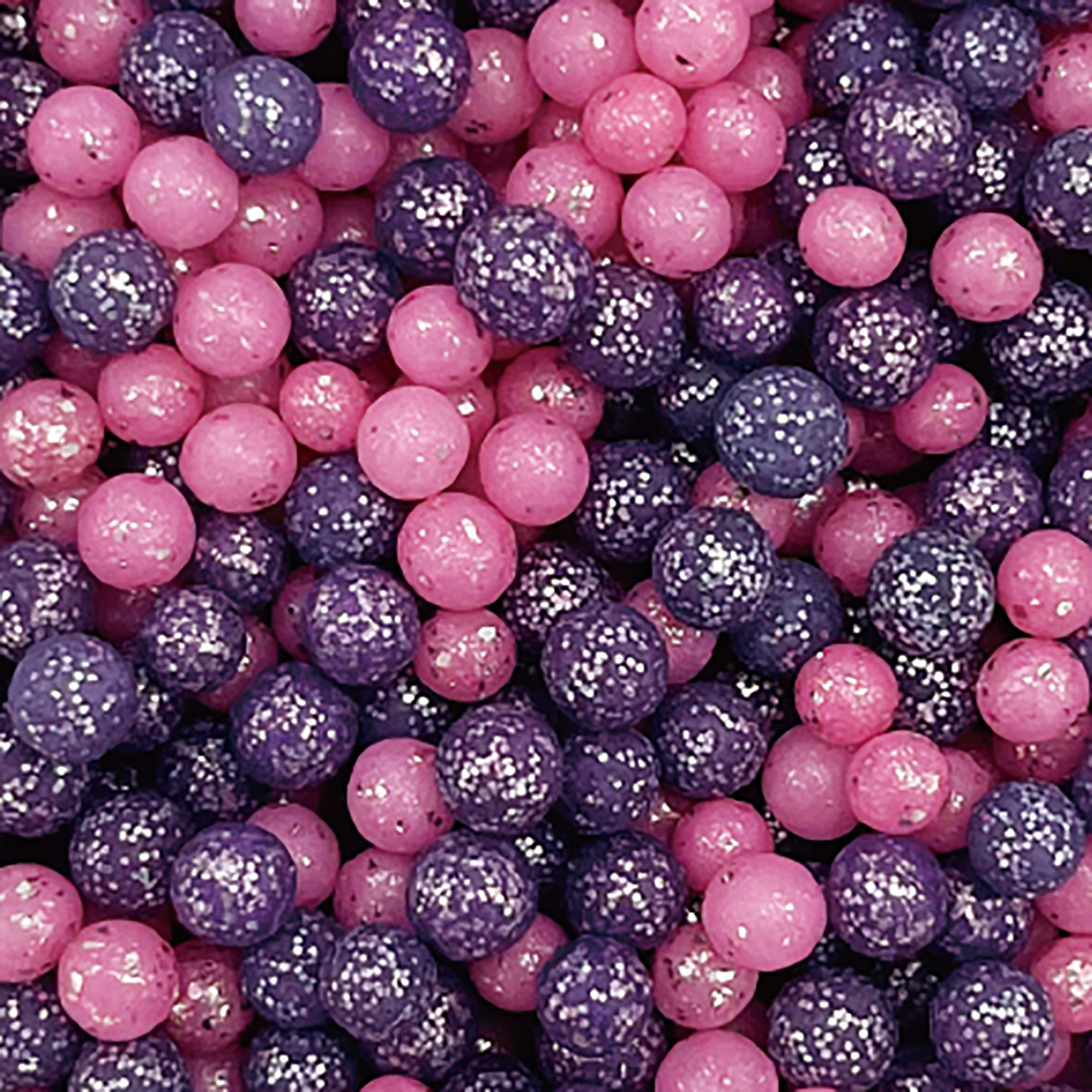
Your procurement strategy dictates your supply chain agility. Choosing between standard bulk glitter beads and bespoke formulations depends on your production volume and brand positioning.
Purchasing off-the-shelf bulk items provides immediate operational advantages. Lower minimum order quantities allow for flexible inventory management. You gain immediate availability and predictable lead times. The formulations are proven and widely tested across the industry, meaning they generally perform well in standard baking applications.
However, you lack exclusivity. Competitors can purchase the exact same visual elements. You also face potential stockouts during peak seasonal demand when manufacturers prioritize larger clients. Standard bulk works perfectly for high-volume staple items like white pearls or silver dragees. It serves as the backbone for baseline inventory and fast-paced seasonal holiday production where speed matters more than unique branding.
Developing a custom colorway involves close collaboration with a manufacturer. You provide Pantone references or physical samples. The lab formulates the color using food-safe dyes, tests it for stability, and sends physical prototypes. Once approved, the manufacturer scales the recipe for commercial production runs using specialized panning and polishing equipment.
Sourcing OEM sprinkles requires planning for higher minimum order quantities. Manufacturers need larger runs to justify halting standard production lines for custom changeovers and wash-downs. You must also account for extended lead times during the R&D phase. If you require unique shapes, you will need to invest in custom packaging dies and extrusion tooling.
Original Design Manufacturing (ODM) offers a middle ground. You can white-label unique, pre-formulated seasonal blends. The manufacturer designs the mix, and you purchase it under your own brand name. This provides a unique product without the lengthy R&D process of a fully custom formulation.
Creating a custom sprinkle mix opens up retail opportunities. Co-packing allows you to purchase materials in 20kg bulk boxes and have the manufacturer repackage them into retail-ready tubs. Dessert suppliers can then retail their own decoration lines directly to home bakers, creating an additional revenue stream.
Partnering with an edible sprinkles wholesale distributor requires deep supply chain analysis. A reliable partner prevents production halts and protects your brand reputation.
Assess the raw material sourcing network. Determine if the vendor is a direct manufacturer or a multi-brand distributor. Direct manufacturers offer better customization and tighter quality control but may have longer lead times for overseas shipping. Distributors provide faster shipping and lower MOQs but add a markup to the final landed cost.
Analyze standard lead times carefully. Domestic sourcing generally guarantees faster delivery. International sourcing often yields better economies of scale but introduces customs clearance delays and ocean freight volatility. Factor these delays into your production schedule to avoid stockouts during critical baking seasons like Q4.
Evaluate the commercial infrastructure of the supplier. Efficient procurement requires streamlined ordering. Does the supplier offer easy online ordering portals with real-time inventory tracking? Quick dispatch for standard SKUs keeps your lines moving. Relying strictly on manual purchase orders and email confirmations increases the risk of human error and delays.
Calculate the total procurement cost accurately. Factor in the product cost, domestic or international freight charges, import tariffs, and potential waste from clumping or damage. A low unit cost quickly becomes a liability if shipping charges are exorbitant or if 10% of the product arrives unusable due to poor packaging.
Vendor consolidation offers significant financial benefits. Bundle your wholesale decorative elements with luster dust, food coloring, and cupcake liners from a single comprehensive supplier. Hitting higher trade volume tiers reduces your overall spend. Consolidating shipments also saves substantially on freight costs and reduces receiving dock congestion.
Negotiate tiered volume agreements based on annual commitments. Guaranteeing a specific annual spend gives the manufacturer predictable revenue. In return, you secure priority production scheduling, dedicated account management, and buffer stock held at the manufacturer's warehouse.
Establish strict protocols for handling defective batches before signing a contract. Define exactly what constitutes a defect. This includes off-spec color matching, irregular sizing, or clumping upon arrival. Outline the exact steps for reporting the issue and requesting a replacement.
Evaluate the return policies and credit processes. A reputable supplier will stand behind their product. They should process credits swiftly for documented defects. Always demand pre-shipment samples from the actual production run for internal QA testing. Do not accept delivery until your lab approves the physical sample.
Transitioning to a new bulk supplier introduces operational risks. Proactive mitigation keeps production running smoothly.
Operational Risk | Mitigation Strategy |
|---|---|
Unexpected Allergen Contamination | Require updated allergen statements annually. Conduct independent third-party lab testing on random incoming batches to verify claims. |
Inventory Spoilage due to Clumping | Specify moisture-barrier packaging in the procurement contract. Mandate foil-lined bulk bags with heavy-duty desiccants. |
Emergency Stockouts | Maintain a hybrid supply chain. Use direct manufacturers for baseline bulk and domestic distributors for quick-dispatch, short-lead requirements. |
Supply Chain Bottlenecks During Q4 | Implement split-shipment contracts. Maintain a secondary, fully vetted backup supplier for critical, high-volume SKUs. |
Color Fading Under Retail Lighting | Request UV-resistant food dyes during the formulation phase. Test finished products under intense fluorescent lighting for 72 hours. |
Request product specification sheets, COAs, and 500g test samples from three distinct suppliers to begin the vetting process.
Conduct internal bake, freeze-thaw, and moisture migration tests using your proprietary recipes and standard display conditions.
Audit your warehouse storage conditions to ensure strict climate control, humidity monitoring, and FIFO rotation.
Negotiate annual volume contracts to consolidate vendors, secure buffer stock, and reduce total landed freight costs.
A: Non-toxic means the product will not acutely harm you if ingested, but it is not formulated as food and the body cannot digest it. Edible means the product is FDA or EFSA approved, made entirely of food-safe ingredients, and is fully digested by the body.
A: Most commercial edible pearls and glitter beads last 12 to 24 months. To achieve this maximum shelf life, you must store them in a cool, dry, dark environment away from high humidity and severe temperature fluctuations.
A: Yes, many manufacturers offer custom blending and bespoke colorways. Creating a custom mix typically requires higher minimum order quantities and longer lead times for R&D, Pantone color matching, and custom packaging dies.
A: You must source high-quality products with fat-soluble coatings. Always test the specific decorative element against your bakery's proprietary frosting recipe under standard display conditions for 48 to 72 hours to verify moisture resistance.
A: You must request up-to-date Certificates of Analysis (COA) for every batch. Ask for detailed ingredient specification sheets, clear allergen declarations, and proof of facility food safety certifications like SQF or BRC.
A: Many formulations are naturally vegan and gluten-free. Cross-contamination remains a major risk in large manufacturing facilities. Buyers must explicitly request certified vegan or gluten-free documentation if required for their specific product claims.
A: Yes, many wholesale distributors also supply luster dust, food coloring, and packaging. Consolidating your purchases helps you reach minimum order thresholds for free shipping and unlocks deeper volume discounts.


