Most first orders go wrong in the gap between the sample and the container, and almost never because of the product itself. Something in the commercial terms was assumed rather than written down: what the minimum order actually covers, what a sample proves, or which of the three lead-time clocks starts when.
This note covers the three questions we are asked most often by first-time buyers, in the order they usually come up.
What the MOQ actually covers
A minimum order quantity is not a single number for a factory — it is a set of run sizes, one per stage. Our standard minimum is 60 kg per SKU, and it is set by two things that do not scale down: the smallest colour batch that can be matched reliably, and the smallest packing run that does not waste film or cartons.
Why the number changes with the specification
- Standard colour, bulk pack — lowest minimum, because both stages run inside an existing setup.
- Custom colour — the minimum is driven by the colour batch, not by the sugar.
- Custom pack — a new film or a new carton adds its own minimum, and usually a tooling or plate cost.
- Mixed pallet — several SKUs can share one shipment, so the minimum applies per SKU, not per order.
The practical consequence: if you need four colours, four SKUs each at 60 kg is a different commercial conversation from one SKU at 240 kg, even though the total weight is the same.
Samples: what seven days proves, and what it does not
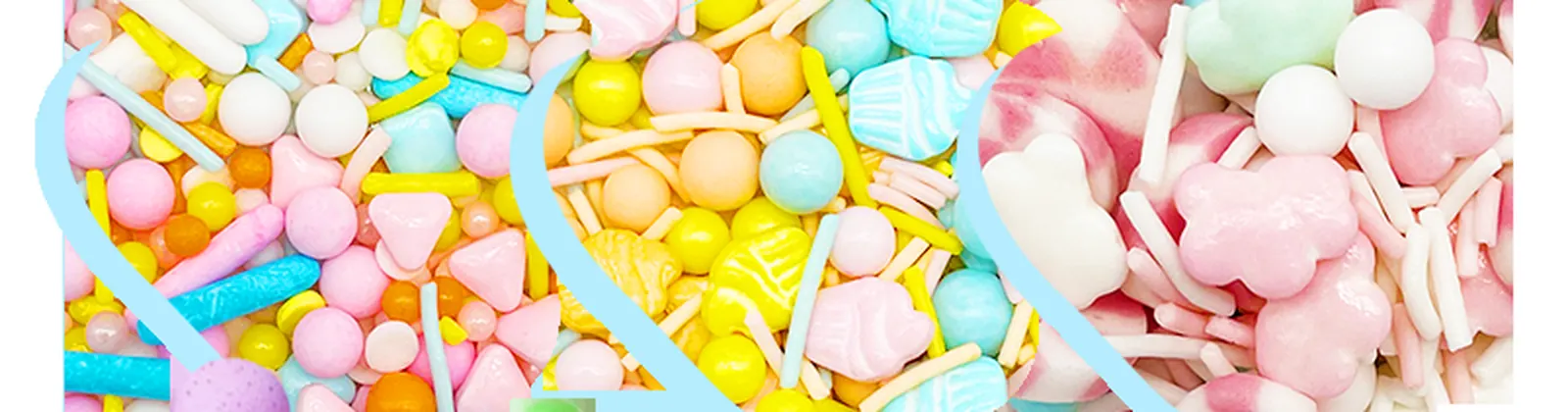
Standard samples ship in about seven days. That is fast enough to keep a project moving and slow enough that it is worth being precise about what you are testing when the box arrives.
Five checks worth doing on arrival
- Colour on your surface — apply it to the actual product before judging the shade.
- Handling — pour it, scoop it, run it through whatever dispenser the line uses.
- Temperature — put a portion in the freezer or the chiller for as long as the real product sits there.
- Pack behaviour — if you specified a bottle or pouch, check that the fill weight looks right in the pack.
- Yield — measure how much covers one unit of product. This is the number that turns a per-kilo price into a per-item cost.
What a sample does not prove: run-to-run consistency, packing accuracy at volume, or how the product behaves after a month in a container. Those are covered by the specification sheet and the certificates, not by a 200 g bag. If consistency is the risk you are worried about, ask for a retained sample from the production run that fills your order — most factories will hold one.
Lead time has three clocks, not one
When a supplier quotes “30 days”, the number is almost always production time only. Two other clocks run before and after it, and both are usually controlled by the buyer.
| Stage | What it covers | Usually delayed by |
|---|---|---|
| Approval | Sample, colour sign-off, pack artwork | Slow feedback on the sample, or artwork changes after approval |
| Production | Colour batch, forming, coating, QC release | Peak season booking, or a specification change mid-run |
| Packing and shipping | Packing run, cartons, booking | Late carton artwork, or a change of destination port |
For a first order with a custom colour and a custom pack, the approval clock is the one that most often eats the schedule — not because it is long, but because it waits on decisions. Approving artwork before the sample arrives is the single easiest way to shorten a first order.
Questions that save a container
These are the four we would ask if we were the buyer. None of them are about price, and all of them change it.
- Which certificate applies to my product, not just to your factory? Certificate scope matters more than the logo — see our note on what each certificate actually covers.
- What is the retained-sample policy? It is the only practical answer to “will the next run match this one”.
- What is fixed and what is negotiable in the spec? A supplier who cannot answer this has not quoted your product, only a catalogue item.
- Who owns the artwork and the mould? Relevant for any custom shape or private label project, and worth settling before the first invoice.
Takeaway
- MOQ applies per SKU, and it is driven by colour batch and packing run — not by the sugar.
- A sample proves the product, not the consistency. Ask for a retained production sample.
- Quoted lead time is usually production only; add approval and packing.
- Approve artwork early — it is the cheapest way to shorten a first order.
If you are at the stage of comparing two suppliers, the same five checks apply to both samples, and the comparison is worth more than a price list. Our quality page lists the certifications and the QC stages a sample passes before it ships.
Need a sample before you commit?
Standard samples ship in 7 days. Send the application, the shade reference and the pack you have in mind, and we will match a sample to it rather than send a catalogue.
Request a sample